

Thursday, December 28, 2023
Tuesday, January 10, 2023

Wednesday, January 4, 2023

Tuesday, April 20, 2021

Saturday, August 2, 2014
Doing the Drone |
| EVER SO CAUTIOUSLY, I moved the left stick forward and watched as it leaped into the air.
There’s
no doubt that 2014 will go down in history as the “Year of the Drone"
within the fishing community. Forget the latest and greatest tackle innovations
or super-duper electronics. Nope, this year the buzz is definitely about drones
and who can take the most awesome photos with them.
The list of people who have
purchased the flying cameras is growing faster than I can keep up! So far, my
WON column partner, Jonathan Roldan, and Ali Hussainy, President, BD Outdoors;
Erik Landesfeind, and Barry Brightenburg all determined they had to have one.
If you search the web, you’ll find plenty of entertaining videos that were shot
with drones by crews and anglers on the sportfishing fleet.
I, too, couldn't resist; mine
arrived in mid-May. By the time it actually got here, I had watched hours of U-Tube
videos on quad-copters in general, and had logged in many how-to hours on the
DJI Technology Phantom 2 Vision Plus website, the drone that I actually
ordered.
The day it arrived, I cautiously
unpacked the carton and followed directions, being very careful when I
assembled the Quad Copter. That’s probably not an accurate statement since all
that was required was that I tighten the self-locking propeller blades and
charge the battery before it was ready to fly. But truthfully, I wasn't quite
ready! I felt a little bit intimidated by this 24- x 24-inch bundle of
technology resting on our coffee table.
I studied the instruction manual
from cover to cover – all 75 pages – for several days. I devoured the
information on the camera, Wi-Fi, GPS, software and cell phone app – all of
which needed to be understood before I took on the challenge of flying this
machine that had set me back about $1,500. I had not been this nervous about
taking control of boats that had cost hundreds of thousands of dollars, and
yes, a few owned by others that were even more dear than that!
Okay, call me crazy, but the only
thing I had ever flown was a model airplane tethered by a control line which I
flew in a circle … often crashing it before the full circle had even been
completed.
Early one morning, after days of
procrastinating, drone in tow Yvonne and I walked across the street to the
park. Going through the checklist printed on the underbelly of the unit as carefully
as a 747 pilot, with great trepidation I turned on the controller, and started
the drone. Ever so cautiously, I moved the left stick forward and watched as it
leaped into the air. Thank God I knew to let go of the stick so it could spring
back to the center! It hovered at 30 feet or so and I began "Doing the
Drone" for real.
For the next few weeks, I flew at
the drop of a hat, taking off from my front yard overlooking the lake. To begin, I flew pretty much straight up and
down, and then slowly, as my confidence grew, the flights extended farther. I
flew it to the edge of the lake, as well as a block or so in either direction,
going higher and higher until I sent it to 250 feet and lost sight of it.
There were remarkably few mishaps. I
discovered the dreaded death spiral when I descended too quickly causing the
drone to drop like a stone! I was in luck! My error was high enough for me to
slow the drone’s descent down so instead of a crash, well, we will simply call
it a hard landing. No fault, no foul, aside from a nicked up prop or two that a
little sandpaper took care of. It was
ready to resume training, but the question is, just who was training who?
Then it came time for me to head to
Baja. I safely stored it in the trusty Roadtrek for the drive down to East Cape
in its own custom case in early June.
Upon my arrival, I flew it
often. Mark and Jennifer Rayor's
beachfront home; at Rancho Leonero; at East Cape RV and then I headed up to La
Paz for WON Panga Slam.
Jonathan Roldan, Tailhunter International,
my WON column partner, and I flew them together at Muertos and Balandra
Bay. Swapping tips we began to grasp the
possibilities that the drone offered. Some of our Drone images ended up in the
La Paz Panga Slam story. I even had the courage to fly it out for the beach
shot at Chileno Bay at the Stars & Stripes tournament’s shotgun start.
Jonathan had two clients who
attempted to use theirs from a panga and ended up float-testing them (by the
way, they don't float). Both were a total loss; however, one was insured.
At this point, almost every flight
drew a crowd full of questions. The best description I've come up with is that
it’s like an incredibly stable tri-pod in the sky with the difference that the
drone will hover in the same place when you release the two joy sticks until
you sort out what you want to do, sort of like a “pause” button.
"Doing the Drone" has
gained momentum within the fishing community.
It has added a dimension that has been missing in this serious challenge
of fishing. Find a drone overhead and
you’ll find grown men once again playing with their toys.
|


Tuesday, August 6, 2013
A foot for Jesus
A foot for Jesus
Gary Graham
Gary Graham
 |
| Greg had accomplished his dream of not only catching his first striped marlin, but catching the largest fish he had ever caught as well. |
Around Christmas two years ago, I wrote an article about a very special Christmas gift, the fulfilling of an impossible dream of my friend and retired Los Barriles sportfishing Captain, Jesus Araiza, who had lost his right foot below the knee through his battle with diabetes, "Baja's Feliz Navidad spirit sparkles." To refresh your memory here is the link to that column: http://www.wonews.com/Blog.aspx?id=1565
Through the kindness and efforts of many good Samaritans, Jesus was fitted for a special prosthesis and began adjusting to the new apparatus. One of those involved in a major way was Greg Birkholz, Arroyo Grande, California, who arranged to have not one, but two "Renegade" feet manufactured by Freedom Innovations, (http://www.freedom-innovations.com/) and donated to Araiza.In early 2001 Greg, himself, was riding his new, big Harley Davidson when it traveled across a center line and collided with an oncoming truck.
“I lost the below-the-knee portion of my left leg requiring me to be fitted with a prosthesis with a "Renegade" foot that I've worn ever since. Also, every limb in my body has some metal in it," he sighed sheepishly.
Birkholz is an avid
sportfisherman in central California and upon hearing of Araiza’s reputation as
one of the finest Captains at East Cape, Birkholz expressed an interest in he
and Jesus fishing together in Baja.
I immediately began
organizing the trip and contacted Axel Valdez, Sales and Marketing Director,
Buena Vista Beach Resort, who without hesitation, agreed to provide Birkholz
and his wife, Lindy, with a week’s stay plus a day’s fishing aboard one of the
hotel's cruisers.
Always following up
on details, I visited Jesus at his home two weeks prior to the planned trip.
Everything was on
schedule.
The Birkholz's
arrived earlier this month on their very first trip to Baja and I flew down the
same day. However, after arriving, I
called to confirm the fishing trip the following day and the tone of Jesus’
voice told me all I needed to know.
“Oh, my friend,” he
began, "I have a problem with the prosthesis and think I better be 'a
lotta be careful' and stay home."
Of course I was
disappointed at the news and knew that Birkholz would be. It was impossible for
me to visit him that night but I was anxious to find out what the problem was.
I met the Birkholz’s
and left them enjoying their dinner on the porch under a star-filled sky on a
pleasant Baja night…a perfect beginning.
Although we were all
disappointed that Araiza was absent, Felipe Valdez, Manager of HBVBR had
reserved "Tres Hermanos"
for the following morning and we headed out toward the rising Baja sun. The
weather was perfect. Trolling, we spotted a few striped marlin but none took
the bait. Greg's excitement heightened with each spotting. Then suddenly we
were in the midst of a large school of cavorting porpoise and among them we
could see yellowfin tuna chasing flying fish. But as more and more boats
arrived at the melee, the tuna fled, frightened by the crowd. And still no
bites for Greg.
Then suddenly the
deckhand, Theodoro -- ironically a grandson of Araiza's -- spotted the
unmistakable sickle-shaped tail of a striped marlin pursuing the bubbling bright-colored
lure in our wake. As fast as you could say ballyhoo,
one was slipped back alongside the lure. The marlin snatched the bait and turned
away from the boat as Greg placed the rod butt in his butt-plate and plopped
down in the fighting chair.
The tug-of-war went
on for more than an hour as Greg slowly gained line, only to lose it back to
the fish. Finally at one hour and seven minutes, Greg had his fish at the side
of the boat and after taking a few photos, the fish was released. Greg had
accomplished his dream of not only catching his first striped marlin, but catching
the largest fish he had ever caught as well.
During the rest of
his stay he caught dorado, explored East Cape on an ATV with Lindy, and visited
Jesus. He discovered that Jesus's prosthesis was too large and a new smaller
one would have to be designed.
So more good
Samaritans were recruited and old ones revisited. Larry Cooper, http://www.bajaenterprises.com/, a longtime Los Barriles’ resident who is in a
wheelchair loaned a spare to Jesus. Charlene Wenger, RN, owner of the newly opened
East Cape Health Center,

http://eastcapemedical.com/how_we_got_started volunteered her staff including Dr. Enrique
Toledo Rodriquez and his assistant, Viggo Ross, to create a mold for the new
device. Paul Boe, who has been involved from the beginning, will travel to La
Paz in late August to meet with Jesus and correct the problem.
So what began as a special
Christmas gift given by countless friends and strangers to a fishing captain
who has spent 63 of his 77 years fishing in a small Baja village, has continued
‘paying it forward’, and a trip for one of the givers, Greg Birkholz, evolved
into a continuing good Samaritan adventure for both old and new volunteers who
graciously continue to donate their time and talents to help others. This is the best of the best!
Wednesday, September 26, 2012
It takes a village
 |
Minerva’s response was immediate. "No problem, honey, I'll
be there," she replied in her usual cheerful fashion.
|
Some
International Game Fish Association (IGFA) World Records are kinda’ by accident
and even taken for granted, especially the first one. But, there are those who
catch record fever after accidently catching that first one…and for others, it
simply becomes a lifelong pursuit. And
for many others, they become World Record “chasers” the moment they become IGFA
members.
The
process itself seems to be very straight forward. Catch a contender, weigh it, measure it,
photograph it, fill out the required forms and submit them to IGFA…with many
individuals involved in the procedure.
For the past
twenty years, I have had the honor of serving as an IGFA Representative-at-Large
in Baja, one of approximately 300 men and women in 90 countries who act as ambassadors of IGFA - a
liaison between the angling interests in their areas across the globe and IGFA
Headquarters in the United States.
Guy Yocom's impressive
catch aboard his boat El Suertudo last week was an example
of what occurs after the catch, both behind the scenes and surrounding the
event.
On Tuesday at 2:04 p.m., Captain
Billy Miagawa, Jr. notified me that Greg Di Stefano, Captain of the El Suertudo, had reported that he was headed for Cabo San
Lucas to weigh in a large yellowfin tuna caught on IGFA regulation tackle
with an ETA some time Wednesday morning.
Coincidently, I had been on-hand
for the last yellowfin all-tackle IGFA world record weigh-in when Mike
Livingston's 405.2 was weighed in at San Diego, Calif., ultimately defeating a
record that had stood for 33 years. I briefly considered flying down for the
weigh-in, but airline schedules eliminated that option.
Instead, I alerted Michael Farrior,
IGFA Trustee here in the U.S. and contacted Minerva Saenz, a long-time IGFA
Representative and owner and operator of Minerva's Baja Tackle and Sportfishing
Charters in Cabo San Lucas informing both of the impending arrival of the potential
world record aboard El Suertudo.
Minerva’s response was immediate. "No
problem, honey, I'll be there," she replied in her usual cheerful fashion.
"I will not only arrange for a local photographer and make sure he takes
all the photos needed, but I will also assist them with the application form
and measurements."
Since the yellowfin tuna had been
caught with a Mustad hook there was a possibility that the catch might be
eligible for the $1,000,000 prize offered by Mustad. Our next step was to notify
Jeff Pierce, Mustad's sales manager.
By Wednesday morning, when the behemoth fish was brought to the
scale, the rumors flying around the Marina became a reality. Clearly the word
was out and a large crowd gathered with Minerva and photographer, Mario Bañaga,
Jr. Minerva supervised the weigh-in and
assisted with paperwork while Mario took the photos.
With the IGFA world record on the line, Captain Greg Di Stefano
confirmed that prior to the trip they had been in contact with Jack Vitek, IGFA
World Records’ Coordinator, sending him samples of line that would be used
during the trip for testing. For that same reason it was decided to weigh the
fish with two different scales and then deliver them to Giesela Muccillo at International
Weighing Systems in San Diego for testing. Giesela indicated that the testing
would be complete sometime during the week of the 24th when the
weight would be confirmed.
Meanwhile photos of the fish taken with cell phone cameras began
appearing across the Internet. One of the first places one appeared with a
brief description was Brandon Hayward's blog on WON.com, followed immediately
by others on Facebook…all with a slightly different versions.
Boat Captain, angler and crew were barraged by individuals on
the dock, as well as by telephone, with questions seeking information that
could be reported. By nightfall a Google search yielded 67 listings about the
catch.
Once
the paperwork is completed it will then be delivered to IGFA for review by Jack
Vitek, who states: "For record approval, we have to wait a minimum of 90
days from the catch date for international claims. That being said, by the time
the application is in our hands…it takes approximately 2 to 3 months, depending
on the travel schedule of the President and Conservation Director as they also
review the applications.”
According to Vitek there are approximately 750 IGFA World Record applications
processed a year, requiring a remarkable amount of effort of what could be
considered a village of IGFA staff, volunteers and many others who become involved
for one reason or another ensuring that each and every World Record application
is evaluated and judged fairly.
Thursday, September 13, 2012
Feeding frenzy fraternity
 |
However, when they occur, one expected bonus is all of the
debris that has been washed out of the arroyos into the Sea of Cortez.
|
Although they created some unwanted flooding, the recent
torrential rains were a welcome relief to locals from the drought-like
conditions that have persisted in Baja Sur for several years. Some of the negative
effects of the downpours, however, were a few lost fishing days for both resident
and visiting anglers and some unhappy tourists. What went unnoticed by many were
the possibilities created by the racing runoff that flowed out to sea along the
beaches, creating deep cuts that became shelter for bait of every description
and very fishable after a few days.
In addition
to sheltering the bait, another bonus is the debris built up over years in the arroyos
that is washed out into the Sea of Cortez. This trash and flotsam provide
excellent cover for plankton, bringing a variety of bait fish that attracts
everything from “schoolie” dorado to billfish. It's not unusual to see boats
racing from pile to pile, similar to their Southern California neighbors doing
the “kelp patty scramble” . . . a popular and exciting way to find fish.
In the 1970s,
within a few weeks after a big rain, my friend Tom Miller, Western Outdoor
News' Baja Editor, described a wild scene of pargo, pompano, roosterfish,
jacks, sierra and even dorado piled up in a feeding frenzy around one arroyo.
Being in
the right place at the right time, anglers may witness epic feeding frenzies
not unlike those experienced at a potluck dinner or a tailgate party. Big fish, little fish – all hardly selective –
slash and snap at anything that moves, suckers for anything offered . . . dead
or live bait, spoons, topwater poppers or even flies.
This phenomenon attracts a cast of
characters including locals and visiting anglers alike – garbed in everything
from barefoot and shorts to official name-brand fly clothing, full dress wading
gear right down to the boots.
One of the
most fascinating elements of the beach action is the mix of tackle and
techniques used by anglers all fishing in the same stretch of beach: catching
fish with handlines wrapped around a beer can; conventional bait casting gear;
spinning gear with rods twice the height of the angler flinging spoons and
poppers easily the length of a football field into the Sea and frantically
retrieving them, while their fly-flinging counterparts wade out in chest high
water to reach the zone.
This
exhibition allows anyone interested to compare the various tackle and
techniques and how they perform under similar conditions . . . the different
live and dead bait along with the various types of spoons and surface poppers
that produce the best results. It’s all here: The advantages of spinning or
conventional tackle; and for fly-fishers, the rod and reel choices, as well as
choices of lines including floating, intermediate and sinking.
It’s sort
of what might be considered an impromptu clinic on how to fish Baja Beaches
with a variety of different tackle by those who do it often! It’s all available by simply showing up and
paying attention.
This year's
rainy season has already produced plenty of success stories including jacks,
roosters and pargo on spinning tackle near the tip; snook on bait at San Jose;
pompano on surface poppers at Punta Arena; and small bonefish on flies at Las
Arenas. It all Indicates that in
addition to the improving offshore fishing, the feeding frenzy fraternity is on
the way to a great late summer and fall.
Saturday, September 8, 2012
Big fish, bent butts, and bowling pin-sized lures
For five days last week, I had the opportunity to rub shoulders with some of the most famous big billfish skippers on the planet. At the invitation of Peter Fithian, the only surviving founder of the iconic 53-year-old Hawaiian Invitational Billfish Tournament, I traveled to Kailua-Kona, Hawaii as one of several writers to cover the event, which included 40 competing international teams from 11 countries.
It was quite a privilege to ride on the HIBT press boat Lana Kila, skippered by Captain Bomboy Llanes, well-known lure-maker and his crewman, Shawn Palmer, racing from one hookup to another during the five-day event to photograph the catch and release, the Marlin Race tagging and the taking of the giant blues for the competition.
Throughout the week, others chose to ride on the press boat on different days: Tim Simpson, Editor/Publisher of Bluewater Magazine; Jim Rizzuto, local sportfishing columnist, author and unofficial historian; Charla Thompson, well known local photographer; and several others.
During the time that no boats were hooked up, Bomboy and Shawn would demonstrate and discuss their theories on lure fishing in Kona, showing us different styles and models of lures, how to position them in the wake as well as explaining different hook-sets and their reason for using them.
Simpson offered some of the results of his research for his The Book of Lures. His explanation on how billfish vision is split with upper and lower part of the eye being sensitive to a different spectrum of colors underwater was fascinating. From extensive collaboration with world-leading scientists, the book contains several chapters detailing how color works underwater. Tim also described how sound and vibration travel beneath the surface, and how they are picked-up and used by fish when hunting or to avoid threats.
Rizzuto has been writing about Hawaii sportfishing since 1963 and he has a long list of books about fishing the area to his credit. For future generations, Jim's columns, articles and books will serve as a history on the way fishing was on the historic Kona Coast blue marlin grounds. He has also collected fishing tackle over the years, but his primary focus is his extensive lure collection dating back to the 1950s. According to Jim, Hawaii's billfish don't fin so they have to be found another way. Three-quarters of all billfish caught in local waters are caught on lures which are designed to anger more than entice … hopefully triggering a violent response.
The largest marlin ever landed on sportfishing tackle, an 1,805-pound Pacific blue, was suckered into attacking a 10-inch lure!
Hawaiian lures are not necessarily designed to look like a baitfish! They do not imitate anything. If the lure is performing correctly, it doesn’t act or look like bait that a billfish might be interested in. It is hard to imagine any big marlin getting excited enough by a small lure to expend the energy required for the pursuit of the tidbit.
Of course at some point, I began to make a comparison of the Hawaii fishery and the waters off the tip of Baja. Having spent the majority of my life fishing Baja, it was inevitable. The local consensus was that Kona would win the "fishery" discussion hands down; I had my doubts.
It seems to me that the odds are heavily favored for Kona to deliver year ’round granders in very close proximity to the harbor. The majority of the local fleet seems to be equipped with heavier tackle and prefers to target the larger fish and consider all other species more or less an incidental catch.
In Los Cabos, the focus most of the year is on variety, with the fleet allowing the angler more light tackle options. So I could go no further with my comparison scientifically, and have to stop. I only know that I would gladly go to either place to fish any time I get an invitation!
By the end of the week I had acquired a sufficient number of Hawaiian-style lures along with enough new tactics and techniques to keep me busy experimenting when I return to Baja in the fall for the billfish and tuna tournaments.
This is what I love about fishing. There is always something new to learn.
It was quite a privilege to ride on the HIBT press boat Lana Kila, skippered by Captain Bomboy Llanes, well-known lure-maker and his crewman, Shawn Palmer, racing from one hookup to another during the five-day event to photograph the catch and release, the Marlin Race tagging and the taking of the giant blues for the competition.
Throughout the week, others chose to ride on the press boat on different days: Tim Simpson, Editor/Publisher of Bluewater Magazine; Jim Rizzuto, local sportfishing columnist, author and unofficial historian; Charla Thompson, well known local photographer; and several others.
During the time that no boats were hooked up, Bomboy and Shawn would demonstrate and discuss their theories on lure fishing in Kona, showing us different styles and models of lures, how to position them in the wake as well as explaining different hook-sets and their reason for using them.
 |
| DURING THE TIME that no boats were hooked up, Bomboy and Shawn would demonstrate and discuss their theories on lure fishing in Kona. |
Rizzuto has been writing about Hawaii sportfishing since 1963 and he has a long list of books about fishing the area to his credit. For future generations, Jim's columns, articles and books will serve as a history on the way fishing was on the historic Kona Coast blue marlin grounds. He has also collected fishing tackle over the years, but his primary focus is his extensive lure collection dating back to the 1950s. According to Jim, Hawaii's billfish don't fin so they have to be found another way. Three-quarters of all billfish caught in local waters are caught on lures which are designed to anger more than entice … hopefully triggering a violent response.
The largest marlin ever landed on sportfishing tackle, an 1,805-pound Pacific blue, was suckered into attacking a 10-inch lure!
Hawaiian lures are not necessarily designed to look like a baitfish! They do not imitate anything. If the lure is performing correctly, it doesn’t act or look like bait that a billfish might be interested in. It is hard to imagine any big marlin getting excited enough by a small lure to expend the energy required for the pursuit of the tidbit.
Of course at some point, I began to make a comparison of the Hawaii fishery and the waters off the tip of Baja. Having spent the majority of my life fishing Baja, it was inevitable. The local consensus was that Kona would win the "fishery" discussion hands down; I had my doubts.
It seems to me that the odds are heavily favored for Kona to deliver year ’round granders in very close proximity to the harbor. The majority of the local fleet seems to be equipped with heavier tackle and prefers to target the larger fish and consider all other species more or less an incidental catch.
In Los Cabos, the focus most of the year is on variety, with the fleet allowing the angler more light tackle options. So I could go no further with my comparison scientifically, and have to stop. I only know that I would gladly go to either place to fish any time I get an invitation!
By the end of the week I had acquired a sufficient number of Hawaiian-style lures along with enough new tactics and techniques to keep me busy experimenting when I return to Baja in the fall for the billfish and tuna tournaments.
This is what I love about fishing. There is always something new to learn.
East Cape: History in the making
 |
| SINCE LAST YEAR, dredging, earth moving and construction has continued, resulting thus far in a rock-lined channel leading into the partially completed marina with home sites surrounding it as well as some docks. |
| Just a click over a year ago, I wrote a column entitled, "Old East Cape Fading." Click here to read article. A recent article on the 13th Annual Bisbee’s East Cape Offshore Tournament caught my eye and the following portion of the report once again emphasized the ever-changing East Cape. "One of the new wrinkles to this year’s event is having two start locations. The first is at tournament headquarters, the Hotel Buena Vista Resort, while the second is just outside the marina entrance to the presenting sponsor, Cabo Riviera. This new golf and boating development, located about 10 miles south, has recently completed dock slips and other amenities. Several of the tournament boats are staying in the marina there, while others anchor off the beach just off from Buena Vista." Talk about history in the making! For the first time ever, visiting sportfishers can actually tie up at a slip in a marina here at East Cape. An email from Nydia Altamirano, Cabo Riviera promotional marketing manager, confirmed that they were hosting 16 sportfishers during this year's tournament. “Jeremy” posted on a Baja forum, "Plenty of room for our 48-foot Riviera, Amelia Marie, a non-tournament boat. Plus, they had electrical hookups and a nice restroom with showers. There is also a dock with a tanker truck alongside selling fuel.” Just down the beach from Hotel Buena Vista Beach Resort stand the remains of what had once been our family’s home for 18 years, Rancho Deluxe. It had stood at the edge of a trailer park, La Capilla, overlooking the Sea of Cortez. The American owners had promised an elaborate seaside-gated community with 200 lots and 100 condominiums as well as a community beach club with a pool, restaurant, and bar. The gringo developers are long gone, the property was sold to Homex, a large Mexican development company, but the land remains as bare as it did in 2006. Another mile or so farther down that same beach is the site of El Anhelo Marina and Resort Project. Last year, I was told that construction would begin as soon as the permit process was completed … within the year. Another ambitious project with a proposed hotel, villas, 500 boat slips, marina village, residential lots and an 18-hole golf course. This was to be built by a partnership of the local Van Wormer family and the El Cid group from Mazatlan. It, too, is still unchanged with no sign of construction or development. Another 10 miles farther down the beach is the 900-acre Cabo Riviera … a proposed 285-slip full-service Marina Harbor for boats from pangas to super yachts. I was told last year that it, too, would be open in 2012. Of all the projects that were promised to become part of the East Cape landscape, this is the only one moving forward. It is actually under construction with condominiums, apartments, boutiques, shops, harbor house restaurant and exclusive yacht club planned along with a five-star 150-room hotel and a championship golf course for guests and residents. Since last year, dredging, earth moving and construction has continued, resulting thus far in a rock-lined channel leading into the partially completed marina with home sites surrounding it as well as some docks. Of course, the project is years from completion, but true to their word, it is open. The owners seem to be dedicated to completing the project and are certainly willing to put their money where their mouth is, pouring incredibly large sums into the venture. Of course, a project of this magnitude attracts critics, skeptics and doubters … all willing to voice their personal opinions of the flaws and mistakes that are certain to result in its failure. Though location and engineering are among the most common of the complaints heard, most seem to be anchored in the resentment of progress. You know that old "NIMBY" attitude – Not In My Back Yard! I sure understand that! I have been traveling in Baja for over four decades. I have witnessed progress in East Cape with all its fits and starts … some welcome, some not; some successful, some not. This is not the place to debate the pros and cons of Cabo Riviera. It’s here, bringing changes. Experience has taught me that in this land where mañana is a mantra, meeting a projected deadline is almost a miracle. The owners of this project lived up to their promise to have the Marina open in 2012, which speaks volumes of their intentions. If they can match that with equally strong implementation, Cabo Riviera will be leading East Cape into the next era. |
Wednesday, August 8, 2012

Tuesday, December 20, 2011
Grass roots tournaments revisited

Pedro and Julio Meza, on the left organize a series of
tournaments throughout the Baja Peninsula, Baja Norte and Baja Sur.
Pedro Sors, a dedicated sportfisherman, is the host and producer of one
of the most popular Mexican television sportfishing shows called Con Caña y
Carrete. He and Julio Meza, a San
Quintin produce grower and owner of FISHCO.com organize a series of tournaments
throughout the Baja Peninsula, Baja Norte and Baja Sur. These tournaments include the Governor's Cup
series which feature a three-venue contest that was held this year in San
Felipe, San Quintin and Ensenada.
Recently, I had the opportunity to meet Pedro and Meza at a Governor's
Cup in San Quintin. Aboard Julio's center
console Contender name "Blessed" speeding out the inner bay with
Julio at the helm, they explained the details of the Governor's Cup series.
The one day tournaments, which are open to anyone, offer prizes of cash
and equipment for the largest fish in both surface and bottom categories for
men, women and children divisions. In addition, anglers accumulate points at
each of the three events that are totaled to determine the combined overall
champions for the series. Each event is featured on the Con Caña y Carrete television
program.
The series was first conceived during the term of Baja Sur’s El Gobernador Narciso Agúndez Montaño in 2006.
It was designed to introduce sportfishing to the locals, involving not only the
adults in the many small communities that dot the coastline of the state, but
the children as well. When El Gobernador
Agúndez left office the incoming Gobernador decided to abandon the series for
economic reasons.
At that point, recognizing that every tournament is an opportunity for sportfishing
education in small communities, Meza and Sors decided to work together to
resume the important series. Punta Eugenia, Abreojos and La Bocana were added
to the list along with the tournaments planned for the future.
Pedro Sors' interest in sportfishing is deep and goes way beyond just
catching fish, which he seems to be doing somewhere in Mexico every week. In
2003 he discovered that sportfishing was not officially recognized by the
Mexican government. It didn't exist legally at that time. The National Council
of Fisheries only recognized groups officially designated by the government.
He began speaking to fishing friends encouraging them to unify and form
a Federation of Sportfishing. Taking advantage of the people he had met though
his television program, several years later in 2005 through his efforts and
those of other friends and acquaintances, the Federación Nacional
de Pesca Deportiva A.C was formed representing
sportfishing clubs in seven Mexican states initially.
Since then, the group has grown to represent sportfishing
clubs in twenty-seven states with a combined membership of 32,000.
According to Sors, founder and past president, some of their
accomplishments include:
Acquiring
two seats on the National Board of Tourism that meets twice a year.
They encouraged
states to facilitate the sale of fishing licenses, allowing the license fees to
be used in individual states.
Convinced
the Secretary of the need for more boat launching ramps resulting in an ongoing
program that resulted in 80 new or improved ramps between 2009 and 2011.
Persuaded
the Federal Secretary of the Treasury, a golfer, to eliminate Boat Permits by
arguing that golfers were not required to pay green fees for their golf carts
so why should the government charge a sportfisherman a fee for the boat he
fishes from.
The Federation
has fielded and won in several International World Sportfishing Championships, as well as hosting Big Game and Bass
championships in Mexico.
The
Federation addressed a law forbidding
filleting fish aboard a boat and convinced the Secretary to amend the
wording to read that it is unlawful to unload
filleted fish.
It was
against the law to fish with live bait. The Secretary was uninformed about
sportfishing. When the Federation explained how many families supported
themselves by selling live bait he realized the law needed to be changed.
These are the kinds
of issues the Federation seeks to change. Though it has had some setbacks and
failures along the way, it has had many successes.
Julio Meza and Pedro Sors, both avid and passionate Mexican sportfishermen,
seem to be taking up where the group I wrote about in May 2009 http://roadtrekker.blogspot.com/2009/05/grass-roots-tournaments.html
left off, continuing to introduce and promote sportfishing throughout Baja. Their efforts on behalf of sportfishing should
be applauded by anglers everywhere!
Saturday, October 22, 2011
Home grown abalone…
I originally met Enrique Espinoza, Cooperativa Progresso Administrator, in 2008 when Juanchy a
colorful local fisherman had arranged a trip for me with the local abalone
divers.
Subsequently I wrote a Roadtrek column titled "A New
Breed…Time Will Tell" praising Enrique and his group's efforts attempting
to restore their local abalone and lobster fisheries to sustainable levels.
I wrote "After
watching the commercial fishermen and their Cooperativa's decimate marine
resource after resource in Baja over the years, listening to Enrique as he
enthusiastically outlined goals and techniques being implemented by his group
to maintain the resources, I couldn’t help but feel a twinge of hope that maybe
some of the new breed of commercial fishermen are beginning to get it
right!"
Recently I returned to La Bocana and was invited by my
friend Enrique to tour their Aquaculture facility where they were growing
abalone. Seriously, home grown abalone?
What a concept! I can see a run
on Aquarium equipment stores when this gets out.
Of course, I accepted and recruited another friend, Pedro
Sors, producer and host of Cana y Carrete, a popular Mexican sportfishing television
program, as my interpreter.

We began the tour of the nearly 9,000 sq ft. facility in a
narrow room with tiled walls and white plastic buckets arranged around the parameter
where a brood stock of twenty abalone mate and reproduce enough larva to
ultimately replenish the abalone harvested, and more.
Using ultraviolet lights to stimulate growth the larvae
begin to grow. When they have reached a predetermined size, they are transferred
into temperature-controlled vats and fed
a carefully monitored plankton diet. They remain in these vats until
they have grown to be visible to the naked eye. The next step is to move the
now visible mollusks to the more than twenty recirculation tanks located in a
large outside area.

Each tank is
equipped with special boxes made of plastic
sheeting for the larvae to cling to as they continue to grow.
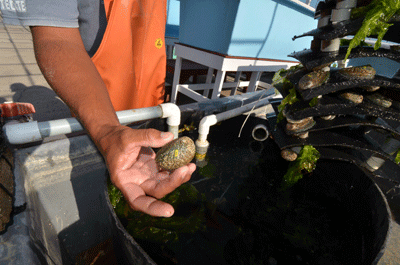
As the crop of eight to nine thousand grow, they are
carefully monitored and each individual abalone is assigned a number which in
placed on the top of their now formed shell, allowing the staff to fine-tune
the diet of each generation for optimum results. Most of the abalone are
transplanted to the wild in ten to eleven months and are about 1 inch in
diameter at that time.
Oceanologist Aguilar Daniel and Jose Manuel Aguilar
technical assistant maintain the facility normally. Only when the workload
increases are additional personnel brought in to assist them.
The entire system was developed initially by visits to
similar facilities in other countries around the world along with the help of
visiting technicians from the United States, Japan and Chile, to name just a
few of the countries that assisted in the early stages of this remarkable
program.
With the knowledge provided and many trial and error
adjustments which allowed for local temperature fluctuations along the Pacific,
as well as adjustments to the algae and seaweed diet, the success rate has grown and the mortality rate
remains at only 5%. The twenty-three year-old program has become extremely efficient,
allowing for the harvest of abalone while returning enough to juveniles to the
beds to maintain the sustainability of this valuable shellfish resource for the
community.
While the Cooperativa's success with the abalone is
impressive, there is much more. The lobster population which was once nearly
decimated by overharvesting along the coast line in the 40-kilometer concession
assigned to the group was recently named as one of five lobster habitats in the
world that have returned to sustainable levels. . .a remarkable achievement for
this remote community of approximately 1,500.
Beginning his
second term as Administrator at the beginning of the year, Enrique
Espinoza, Cooperativa Progresso Administrator's
excitement is infectious as he explains the successes of his group. His eyes
sparkle as he proudly gives the details of how the nearly 200 members
voted to forbid gillnets in the nine-mile-long La Bocana estero effective at
the beginning of 2011, and the protection of Merro (black seabass and grouper)
making it illegal to catch them commercially as well as limiting them recreationally.
To replace the loss of income for the local fishermen, he is
now encouraging members to look to sportfishing for a more reliable income
stream. His organization now offers several programs for members to purchase on
credit quality sportfishing equipment at a deep discount for those who choose
that path, as well as promoting the nine-mile estuary for sportfishing,
building small cabins, and training members to conduct sportfishing trips.
Cooperativa Progresso
and their leader, Enrique Espinoza, are a shining light in the dimly lit
world of Baja commercial fishing.
Friday, October 7, 2011
La Bocana hosts Grande Torneo
Several of my friends have accused me of flying low when I
drive back and forth on Mex 1. Over Labor Day weekend I had the opportunity to
do just that. I was invited to fly to La Bocana, Baja Sur, in a Cessna 402 with
the organizers of the Torneo Internacional de Pesca.

We departed from Ensenada Military airport at midday and flying
at low altitude down the west coast of Baja, gazing down on the sprawling Baja
countryside punctuated by small fish camps, villages and towns on miles of
deserted beaches and wide open spaces, it was a fascinating revelation of how
much of Baja is still undeveloped.
The entire trip to Abreojos, including the brief landing at
San Quintin to pick up the remainder of the tournament staff, was slightly less
than three hours. (Note to self: Find
sponsor to cover flying cost!). As
the plane taxied to a stop on the dirt airstrip and the door flew open, a group
of Cooperativa Progresso members led by President Enrique Espinoza greeted us.
After introductions, handshakes and abrazos, everyone entered the waiting
pickups and headed north for ten miles to La Bocana leaving a cloud of dust; then
straight to the beach where bright orange canopies provided shade from the
blazing afternoon sun for the growing crowd of eager fishermen.
Business was brisk at
the tables of local and visiting entrepreneurs
that were covered with both new and used tackle as would-be anglers tested the bend of the
rods and the smoothness of the reel drags. Of course there was a coffin-sized
cooler filled with soft drinks and cerveza covered with ice that attracted its
own crowd.
Throughout the afternoon, sponsors and organizers Pedro Sors,
owner of Caña & Carrete, and Julio
Meza, owner of Fishco, the largest
Shimano dealer in Baja, renewed old friendships while making new ones. The big
swell and large surf that had pounded the beaches all week was a major topic of
conversation that at times was nearly drowned out by blaring Mexican music. By six
o’clock, 121 anglers fishing on 35 boats had registered and paid their $25
entry fee which included their boat fee.
The music was silenced and the Captains’ meeting was called
to order. Tournament officials covered the tournament rules, based on I.G.F.A.
rules, in detail, as well as the Mexican Sportfishing regulations and the
qualifying species which included yellowfin tuna, dorado, marlin, yellowtail
and halibut. Noticeably missing from the list were grouper
and black seabass.
Late last year the members of Cooperativa Progresso voted to
implement several changes in the regulations in their area. Grouper and black
seabass would no longer be fished commercially; furthermore only one of either
species may be caught per day with sportfishing tackle and it MUST be
released. Another significant change was
that the entire esteros is now off limits for gillnets of any kind. Both rule
changes were effective January 1, 2011. Hopefully other Cooperativa's will
follow Progresso's lead in the future. Imagine Magdalena Bay without nets?

When the meeting was finished, the music resumed and the
party continued into the night. Early Saturday morning the beach was a beehive
of activity as anglers found their assigned boats and loaded their gear. At
exactly 7:00 a.m., Julio Meza fired the flare signaling the beginning of the
tournament. As the boats sped out of the boca, it was clear that the favored
direction was to the north toward San Hipolito.
By the time the weigh-in began a 3:00 p.m., the beach was
packed with family and friends. While some children played in the water, others
were fishing for the prizes reserved just for them. Meanwhile a Mexican band
played as fish were brought to the scale. An animated volleyball game
entertained others. Closer to the beach a small traditional Mexican combo drew
its own crowd. Carne de Puerco tacos with all the trimmings was served for
anyone who was hungry. Of course the huge cooler had been refilled and people
crowded around for just one more drink.

As the fish were weighed, the seven largest were hung up for
display only to be replaced as a larger one came in. By the end of the day it
was clear that though the fishing was good, the yellowtail had dominated the
catch and the event had become a "yellowtail shootout" though there
were a few small dorado and halibut. The largest fish was a 31+ pound yellow
and prizes were awarded through the 7th largest plus special awards for fish
caught from the shore by young anglers.
The event was sponsored by Cooperativa Progresso, Julio
Meza, Fishco, Shimano and Pedro Sors of Caña y Carrete.
Wednesday, October 5, 2011
Home grown abalone…
I originally met Enrique Espinoza, Cooperativa Progresso Administrator, in 2008 when Juanchy a
colorful local fisherman had arranged a trip for me with the local abalone
divers.
Subsequently I wrote a Roadtrek column titled "A New
Breed…Time Will Tell" praising Enrique and his group's efforts attempting
to restore their local abalone and lobster fisheries to sustainable levels.
I wrote "After
watching the commercial fishermen and their Cooperativa's decimate marine
resource after resource in Baja over the years, listening to Enrique as he
enthusiastically outlined goals and techniques being implemented by his group
to maintain the resources, I couldn’t help but feel a twinge of hope that maybe
some of the new breed of commercial fishermen are beginning to get it
right!"
Recently I returned to La Bocana and was invited by my
friend Enrique to tour their Aquaculture facility where they were growing
abalone. Seriously, home grown abalone?
What a concept! I can see a run
on Aquarium equipment stores when this gets out.
Of course, I accepted and recruited another friend, Pedro
Sors, producer and host of Cana y Carrete, a popular Mexican sportfishing television
program, as my interpreter.

We began the tour of the nearly 9,000 sq ft. facility in a
narrow room with tiled walls and white plastic buckets arranged around the parameter
where a brood stock of twenty abalone mate and reproduce enough larva to
ultimately replenish the abalone harvested, and more.

Using ultraviolet lights to stimulate growth the larvae
begin to grow. When they have reached a predetermined size, they are transferred
into temperature-controlled vats and fed
a carefully monitored plankton diet. They remain in these vats until
they have grown to be visible to the naked eye. The next step is to move the
now visible mollusks to the more than twenty recirculation tanks located in a
large outside area. Each tank is
equipped with special boxes made of plastic
sheeting for the larvae to cling to as they continue to grow.

As the crop of eight to nine thousand grow, they are
carefully monitored and each individual abalone is assigned a number which in
placed on the top of their now formed shell, allowing the staff to fine-tune
the diet of each generation for optimum results. Most of the abalone are
transplanted to the wild in ten to eleven months and are about 1 inch in
diameter at that time.
Oceanologist Aguilar Daniel and Jose Manuel Aguilar
technical assistant maintain the facility normally. Only when the workload
increases are additional personnel brought in to assist them.
The entire system was developed initially by visits to
similar facilities in other countries around the world along with the help of
visiting technicians from the United States, Japan and Chile, to name just a
few of the countries that assisted in the early stages of this remarkable
program.
With the knowledge provided and many trial and error
adjustments which allowed for local temperature fluctuations along the Pacific,
as well as adjustments to the algae and seaweed diet, the success rate has grown and the mortality rate
remains at only 5%. The twenty-three year-old program has become extremely efficient,
allowing for the harvest of abalone while returning enough to juveniles to the
beds to maintain the sustainability of this valuable shellfish resource for the
community.
While the Cooperativa's success with the abalone is
impressive, there is much more. The lobster population which was once nearly
decimated by overharvesting along the coast line in the 40-kilometer concession
assigned to the group was recently named as one of five lobster habitats in the
world that have returned to sustainable levels. . .a remarkable achievement for
this remote community of approximately 1,500.
Beginning his
second term as Administrator at the beginning of the year, Enrique
Espinoza, Cooperativa Progresso Administrator's
excitement is infectious as he explains the successes of his group. His eyes
sparkle as he proudly gives the details of how the nearly 200 members
voted to forbid gillnets in the nine-mile-long La Bocana estero effective at
the beginning of 2011, and the protection of Merro (black seabass and grouper)
making it illegal to catch them commercially as well as limiting them recreationally.
To replace the loss of income for the local fishermen, he is
now encouraging members to look to sportfishing for a more reliable income
stream. His organization now offers several programs for members to purchase on
credit quality sportfishing equipment at a deep discount for those who choose
that path, as well as promoting the nine-mile estuary for sportfishing,
building small cabins, and training members to conduct sportfishing trips.
Cooperativa Progresso
and their leader, Enrique Espinoza, are a shining light in the dimly lit
world of Baja commercial fishing.
Angling and diving area wins development smack down

Not an everyday occurrence, but it barely raises eyebrows when a yellowfin tuna or dorado is taken from the beach in this area.

Ray Cannon wrote about the area and its steeply sloped contoured bottom plunging to 100 fathoms a mere quarter of a mile from shore.
Punta Arena, often
referred to as the Lighthouse, has been a long-time angling favorite for locals
and visitors alike. Ray Cannon wrote about the area and its steeply sloped contoured
bottom plunging to 100 fathoms a mere quarter of a mile from shore. Nowhere
else in the Sea of Cortez will you find depths that close to the shore. Not an
everyday occurrence, but it barely raises eyebrows when a yellowfin tuna or
dorado is taken from the beach in this area. Trophy-sized roosterfish are often
landed here practically is the shadow of the towering lighthouse.
A little farther
down the beach toward Baja's tip, Cabo Pulmo was another of the jewels of the
Baja mentioned by Cannon. The pristine
beaches of Cabo Pulmo National Marine Park border a shallow bay that is home to
one of only three hard-coral reefs that exist in North America. Surrounded by an
undeveloped desert and a remarkable mountain range, the Park was established in
1995 after the over-fishing by commercial and recreational fishermen caused an
alarming decline in marine life. At one time it was slated for development, but
thanks to the efforts of local and international conservation groups, it is now
a protected national park, a regenerative area for hundreds of species which
includes four of the seven species of sea turtles that arrive here to nest on
its beaches, or breed and forage in surrounding waters.
In the 16 years
since Cabo Pulmo was protected, the fish community has recovered and is now considered
among the most healthy in the Sea of Cortez making a case for the importance of
protected marine areas.
For the past
several years much of the property, including the beachfront from the
Lighthouse at Punta Arena in East Cape to the northern edge of Cabo Pulmo, has
been purchased by a group from Spain.
The Alicante
(Spanish) group, Hansa Urbana, with approval already granted by environmental
authorities planned a mega-development covering
3,800 hectares, an area the size of the city of San Jose del Cabo, the largest
of all of the proposed developments in the Cape region. The project will
include a marina dug into the coast, golf courses, homes, hotels and condos, a
new airport for private jets plus a commercial center and a small city to house
workers. Future projections include upward of 20,000 people adjacent to
Cabo Pulmo and Punta Arena with up to 30,600
hotel rooms, or 10,200 more homes.
In an area that is
sparsely populated that contains fragile ecosystems and a limited water supply,
a larger population is not sustainable. Along with many other
locals, the director of the Cabo Pulmo National Park, Javier Alejandro
Gonzalez, voiced his concerns that a development of this magnitude would
overwhelm the fragile eco-system of the area. Their views were shared by a group of environmental NGOs that
have formed a coalition to fight for the reef and to stop the development.
That group is led by the U.S. [NGO] Wildcoast;
the Mexican [NGOs] Niparajá, Pro Natura Northwest, Community and Diversity,
[and] Friends of Cabo Pulmo; [and] academics from Scripps Center in the U.S.
and the Autonomous University of Baja California Sur.
Fay Crevoshay, the Communications Director of the
Wildcoast, argued that the several golf courses for the tourist citadel will
have "used chemicals that will flow into the sea when it rains and will kill
the coral."
She also said it is "schizophrenic" for
Mexican authorities [to have created] a national park, which they preserved for
years, and then "they grant a permit to a developer in order to destroy
it."
According to the Gringo Gazette, a local
newspaper in Los Cabos, Representative Elvira Quesada of Semarnat, the Ministry
of Environment and Natural Resources at the federal level, said that the Cabo
Cortés development is currently being reviewed by more than 100 scientists from
many different organizations who are working on the environmental impact
statement which is needed for the project to continue. This is the first time
that various oversight agencies have worked together on an impact statement. More
studies are needed besides the impact statement and they will take years to
complete. For the project to continue, these studies must prove beyond any doubt that no harm will come
to the protected Cabo Pulmo Marine Park.
It appears that with the Government’s renewed
interest, along with the economic woes of Cabo Cortes, Cabo Pulmo Marine Park,
along with one of the richest fishing and diving sites in Baja California Sur,
will remain safe for a while longer.
July Journey Reflections

The San Ysidro border crossing is also currently being remodeled.
While most Baja travelers who drive Mex 1 don't do
back-to-back trips in the same month, I've been doing just that this past month.
I drove down in the Roadtrek in early July, flew back home and drove our Ford SUV
to Ensenada and back across the border for the WON Coral Tournament, flew back to
East Cape for the Bisbee Offshore and then drove the Roadtrek north to
California.
Driving down in early July, the grade south of Loreto before
Insurgentes was crawling from bottom to top with road crews and heavy equipment
removing all the blacktop from the road leaving bare dirt. No news there. In
recent years, road repairs have been commonplace up and down the peninsula.
What impressed me this time was that on my return trip a month later the grade
had been totally repaved and with the exception of painting the centerline, it was
complete.
More recently, road crews are busy on the highways between
El Cien and Constitución, south of Loreto, north of Loreto, Bay of Conception,
north of Jesús Maria, between Punta
Prieta and Cataviña, between San Quintín and Santo Tomás, from the top of the
ridge north of Santo Tomás Valley toward Maneadero before Ensenada. And one
more repair item, the San Ysidro border crossing is also currently being remodeled.
All of this construction prompted several Baja veterans to declare that their recent
drives were the worst in twenty-five years. This was bad timing on their part,
but twenty-five years ago there were pot holes large enough to lose a rig in and we would have welcomed construction crews.
If you are driving down soon, allow some extra time for the
delays caused by the many delays where the roads are being repaired your next
drive on Mex 1.
As for the cost of fuel, on this trip fuel was $2.80 per gallon
for magna and diesel was about $2.84.
In 2005 at East Cape authorities began enforcing a 'no ATV's
on the beach' policy with inspectors patrolling the beaches issuing fines and
in some cases, confiscating equipment. While I completely agree with the decision
to enforce the law, fishing the beach on ATV's was my personal favorite method
of fishing. This trip there seemed to be a continuous stream of bikes of every
description cruising up and down the East Cape beaches, and I didn't hear of
any inspectors patrolling the beaches.
We did fish the beach with fly rods for several days in July
and the four anglers I was with all caught their first rooster from the shore.
Nothing huge, but fishing was good and they all had shots at quality fish.
In response to a recent Roadtrekker column where I spoke of
the kindness of the Mexican workers when I had a flat, one reader sent me another
good Mex 1 story:
"I was driving alone northbound on a weekend that was
also a Mexican holiday. As I approached
the large military checkpoint to the north of Jesus Maria there were hundreds
of vehicles backed up. After an hour of
creeping along, I was finally at the start of the inspection lanes. I got out to stretch my legs and struck up a
conversation with an officer surveying the chaos. He asked where I was going. I explained I was driving to my casa in
California and that I had not seen my wife in eight weeks. I added that I loved her very much and was
looking forward to seeing her. He said
"No hay problema" and motioned my truck out of line and to the
front. He then instructed the soldiers
to pass me through. I guess that the sympathetic officer had a wife or novia
that he missed, too.
I should mention that the exchange with the officer was
totally in Spanish. I must of sounded
pretty 'soapy' to him...mucho amor...solitaro... separatos"...Roger F.
A long time reader and WON Tuna Tournament participant , Joe
McGinnis, is planning his 6th Trailer
Buddy Boat Cruise from 10/25/2011 'til 11/25/2011. Since this will be his sixth fishing cruise,
he has it pretty well dialed in.
His trip includes a couple of weeks at Mag Bay, Lopez
Mateos/San Carlos fishing for wahoo, marlin, tuna in the Pacific ( Thetis Bank)
and some inshore estuary snook, etc…then returning to the Sea of Cortez at
Santa Rosalia/San Bruno. From there he plans to cross over to San Carlos
(mainland Mexico) and Guaymas for a week and then back across to PTO Escondido
stopping at many islands.
Anyone interested can contact him at 805 581 2504, at itzlinda@sbcglobal.net or at Vagabundoswww.vagabundos.com
Subscribe to:
Posts (Atom)